 We ship Canada Wide!




You Don’t Get Sued for Not Having an AED
Posted by AED Solutions on 21st Jan 2026
Posted by AED Solutions on 21st Jan 2026
In 2023, a Calgary office manager called 911 during a sudden cardiac emergency.
An AED was mounted roughly 40 feet away.
She didn’t use it.
When dispatch asked why, her answer was simple:
“I thought only paramedics could use those.”
The outcome was tragic.
The problem wasn’t the absence of an AED.
It wasn’t faulty equipment.
It was hesitation.
There is a persistent belief in Canadian workplaces that AEDs require training, certification, or medical authority to use.
They do not.
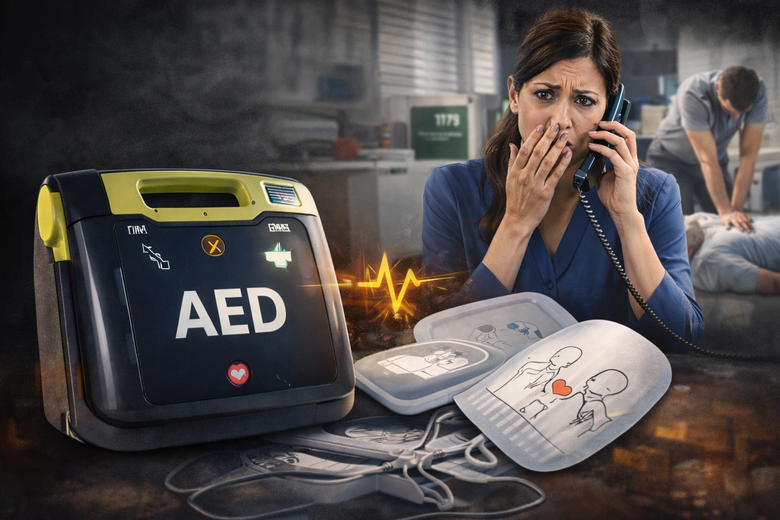
Modern Automated External Defibrillators (AEDs) are specifically designed for untrained bystanders. They are built to be used immediately, under stress, before professional responders arrive.
An AED:
Automatically analyzes heart rhythm
Will not deliver a shock unless it is required
Provides clear, step-by-step voice instructions
Includes visual pad placement diagrams
Performs self-checks and displays readiness
In Canada, anyone is allowed to use an AED.
No certification is required.
No permission is needed.
The device guides the user through every step.
For many workplaces, reviewing how AED defibrillators are designed and what features are standard helps remove uncertainty before an emergency ever occurs.
Many organizations believe that once an AED is installed and inspected, the risk is addressed.
In real emergencies, AEDs are often not used because people hesitate.
That hesitation usually comes from uncertainty:
“Am I allowed to use this?”
“What if I make a mistake?”
“Should I wait for paramedics?”
In a cardiac emergency, waiting is the most costly decision.
AEDs are not backup equipment.
They are the first line of response.
Canadian Good Samaritan protections exist to encourage action during emergencies.
In practical terms:
Individuals acting in good faith are protected
Users are not expected to be medically trained
The law recognizes that emergencies are imperfect
Legal scrutiny rarely focuses on whether someone used an AED incorrectly.
It focuses on whether reasonable help was available and no attempt was made.
Using an AED does not increase liability.
Failing to act when one is available raises questions.
AED manufacturers assume the user:
Has never used the device before
Is under extreme stress
Has no medical background
That’s why Our Products:
Speak clearly and repeat instructions
Use universal symbols instead of technical language
Prevent shock delivery when it is unsafe
Guide the user automatically
An AED will never ask for credentials.
It will only ask you to follow the prompts.
Exploring different AED models helps teams see firsthand how much guidance is built into modern devices.
When AEDs are not used, the issue is rarely technical.
The most common reasons include:
The AED is not clearly visible
Employees are unsure they are allowed to use it
The device is difficult to access
These are clarity and accessibility problems — not equipment problems.
Visibility, maintenance, and simplicity matter more than policy documents.
You do not need complex programs or extensive training to make AEDs effective.
Focus on the basics:
Place it in a high-traffic area with clear signage. Avoid locked cabinets or restricted locations.
Many organizations improve visibility with AED cabinets and accessories that clearly mark the device and draw attention when opened.
An AED behind a desk or in a back office creates hesitation. Immediate access removes doubt.
Perform regular visual checks. Confirm battery status and pad expiration. Log inspections.
Reviewing AED batteries and replacement pads ensures the device is ready when needed.
Employees don’t need to memorize procedures. They need to know one thing:
Open the AED. Follow the instructions.
The real risk is standing in front of one and hesitating.
AEDs are designed to support ordinary people in high-pressure moments.
They remove guesswork.
They guide action.
When people understand that they are allowed to act — and that the device will guide them — hesitation disappears.
AED readiness is not about perfection.
It’s about clarity.
If your workplace has:
A visible, accessible AED
A maintained device
Clear messaging that anyone can use it
You have removed the biggest barrier to action.
For organizations reviewing emergency readiness, explore our AED defibrillators, replacement pads, batteries, and accessories.
Most workplace safety conversations focus on paperwork and policies.
Real emergencies don’t.
When seconds matter, people act based on what they believe is allowed — not what’s written in a binder.
AEDs are built for immediate use, by anyone, with guidance included.
Make that understanding unmistakable.


